Three Hundred Bucks and a Dream: We Built a Real Linux Studio on a Thrift-Store Laptop
Everybody tells you the same thing: you need a beefy machine for audio. And sure, if you're running 60-track orchestral sessions through half a dozen convolution reverbs, you do. But most of us aren't doing that. Most of us are tracking vocals, programming drums, mixing podcasts, and sketching beats. So we wanted to find out how little money it actually takes to get a dependable Linux production rig in 2025.
The budget: $300, including the laptop. Here's how it went.
The Machine: A $280 ThinkPad T480
We went with a used Lenovo ThinkPad T480 off eBay — a machine that's basically the white Toyota Corolla of the Linux world. Eighth-gen i5, 16GB of RAM (upgraded to 16 if the seller hadn't already), and an SSD that someone swapped in before flipping it. Why the T480? Two reasons: it's cheap because businesses dumped them in bulk, and it's got a reputation for rock-solid Linux hardware support. No exotic Wi-Fi chips, no weird ACPI nonsense.
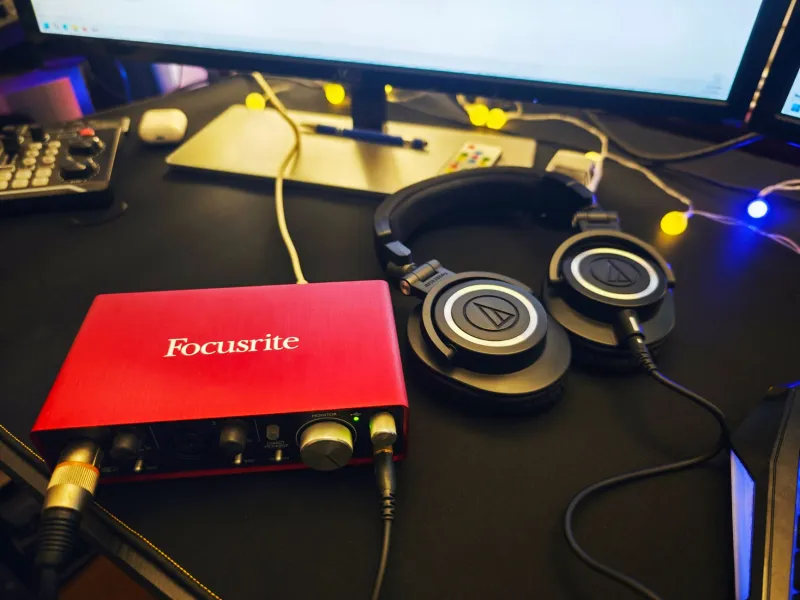
Total damage, including shipping and a new charger: $281. That left us about twenty bucks, which went to a USB-A to USB-B cable for the interface we already owned.
The OS: Where Every Dollar Counts
We installed Ubuntu Studio 24.04 with the low-latency kernel. Could we have gone leaner with a window manager like i3? Sure. But this is supposed to be a practical machine, not a lifestyle statement, and Ubuntu Studio gets you JACK or PipeWire configured out of the box.
After boot, the machine idled using under 1.2GB of RAM. That matters, because on a budget box, every megabyte you don't waste on eye candy is a megabyte your sampler can use.
The Software Stack: All Free, All Lightweight
Here's the shopping list, and the price is the best part:
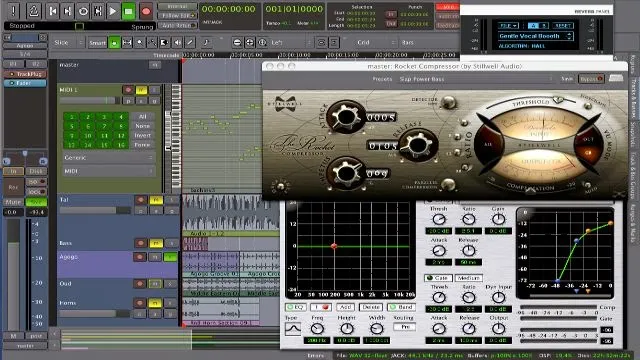
- Reaper — technically $60 for a commercial license, but the evaluation is unlimited, and plenty of hobby producers run it unlicensed while saving up. On Linux it's native, fast, and rock stable.
- Carla — plugin host for anything that doesn't fit neatly into Reaper.
- Vital — the synth that made expensive wavetable synths nervous. Runs beautifully on modest hardware.
- Cardinal — a full modular environment that somehow runs lighter than you'd expect.
- Dragonfly Reverb, LSP plugins, x42 suite — the bread-and-butter mixing tools that cost nothing and eat almost no CPU.
- FluidSynth with a decent soundfont — for when you need a piano sound and need it now.
Notice what's missing: giant orchestral libraries, Kontakt, anything with a 40GB sample install. That's the tradeoff at this price, and honestly, it's less of a limitation than you'd think.
The Benchmarks: Real Sessions, Real Numbers
Talk is cheap, so we ran three sessions and pushed until the machine cracked.
Session one: a 24-track indie rock mix. Drums, bass, guitars, vocals, with Dragonfly Reverb on two buses, a couple of LSP compressors, and Vital handling a synth pad. At a 128-sample buffer at 48kHz, the T480 sat around 22% CPU load. We could have run this session on a potato with a heatsink.
Session two: electronic production. This is where things got interesting. Twenty instances of Vital would obviously melt the thing, but a realistic patch — six synth tracks, a sampled drum kit through Hydrogen, and Cardinal doing generative weirdness — ran at 45% CPU at 256 samples. Usable. Not luxurious, but usable.
Session three: the breaking point. We loaded a 12-instance Cardinal patch with heavy feedback networks and a convolution reverb on the master. At 64 samples, xruns everywhere. At 512 samples, it ran but latency made playing parts feel like performing underwater. The ceiling is real, and it's around 30–35 plugin instances of moderate weight before you're managing buffers instead of making music.
The takeaway: this laptop comfortably handles tracking and mixing for anything short of sample-heavy orchestral work. That covers a staggering amount of what working producers actually do.
Who Is This Actually For?
Three groups, honestly. First, the producer who wants a dedicated second machine — something that lives in a closet, boots in ten seconds, and never touches the internet-browsing, game-playing main rig. Second, the person whose Windows laptop just died and who'd rather spend $300 than $1,500. Third, anyone curious about Linux audio who wants to experiment without financial risk.
What you're not getting at this price: headroom for huge sample libraries, fast bounce times on massive sessions, or the ability to run a modern commercial plugin suite through Wine without friction. Know that going in.
The Verdict
A $300 used laptop running Linux in 2025 is a legitimately capable production machine for the majority of everyday audio work. The open-source plugin ecosystem has quietly gotten good enough — and lightweight enough — that the old excuse of "my computer can't handle it" doesn't apply to most projects anymore.
Is it your main machine for a 120-track film score? No. Is it a rock-solid beat sketchpad, podcast rig, or mix station? Absolutely. And unlike a $300 Windows laptop, this one will still be booting reliably in five years.
If you've been waiting for a sign to build a cheap Linux side rig, this is it. The T480 is sitting on eBay right now, and it's waiting for you.